When a Cabinet meeting becomes a test of the State
|


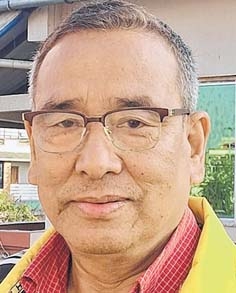
Dr Raj Singh
There are moments in politics when a routine administrative proposal quietly transforms into a referendum on sovereignty.
The decision by Chief Minister Y Khemchand to convene a full Cabinet meeting in Senapati, travelling through Kangpokpi along NH2, appears, at first glance, as an outreach gesture. A Government physically reaching the hills. A message of inclusion. A sign of resolve.
But in the current climate of Manipur, no executive movement is merely logistical. Every kilometre travelled carries political meaning. Every location chosen becomes symbolic. And that is why this proposal demands deeper examination.
The Binary Trap Before the Government
The Government faces a delicate dilemma.
If the Chief Minister proceeds under heavy security, critics will describe it as a display of majoritarian force-a protected convoy asserting passage through contested terrain, while ordinary citizens still negotiate invisible boundaries.
If the visit is postponed or disrupted, the State risks appearing vulnerable-as though Constitutional authority depends on the tolerance of non-State actors.
In both scenarios, legitimacy suffers.
The issue, therefore, is not about Senapati alone. It is about the order in which normalcy is restored. When highways are not yet fully trusted by all communities, political caravans cannot be the proof of peace.
Authority demonstrated under escort is not the same as authority accepted without it.
Authority Is Not a Convoy
The Constitution of India does not recognize segmented mobility. Article 14 guarantees equality before the law. Article 19(1)(d) affirms the right to move freely throughout the territory of India. Article 21 protects life and liberty.
When ordinary citizens feel unsafe travelling across districts, the Constitutional deficit is real.
The German sociologist Max Weber described the State as the entity claiming a monopoly over the legitimate use of force within a territory. But legitimacy, not force, is the enduring pillar.
A convoy of Ministers may move through under protection. But legitimacy is proven when:
* A patient crosses districts for treatment without fear.
* A trader transports goods without informal “permissions.”
* A student travels to college without anxiety.
The State’s strength lies not in how securely its leaders move, but in how securely its citizens live.
The Unwarranted Romance of the Roaming Cabinet
Under former Chief Minister N Biren Singh, the “Go to Hills” initiative introduced the concept of Cabinet meetings in hill districts. At the time, it was presented as a bridge-building exercise. But even then, serious concerns existed.
A roaming Cabinet is logistically enormous. Secu- rity risks for VVIPs multiply in remote terrains.
Convoys stretch long. Administrative hours are consumed in travel and arrangements. Public funds are spent disproportionately on security and logistics rather than service delivery.
Such an exercise may generate headlines initially. But it is inherently unsustainable. Once discontinued, as inevitably happens, it risks being remembered not as institutional reform but as a political gimmick.
Governance cannot be episodic theatre.
Even in calmer times, operational risks were visible. A convoy returning from a Cabinet meeting in Tamenglong in January 2018 met with an accident, injuring escort personnel. The risk was foreseeable because mobility in difficult terrain is not ceremonial.
Today’s context is far more fragile. What may have been symbolic outreach before 2023 now carries the weight of territorial sensitivity.
Precedent does not automatically equal prudence.
The Sanctity of the Seat of Governance
There is a deeper structural concern - one that is often dismissed as abstract, but is in fact foundational. The Seat of Governance must remain sacred.
Imphal is not merely an administrative cluster. It houses the Manipur Legislative Assembly, the Secretariat, and the Governor’s residence. It is the Constitutional nerve centre of Manipur.
Capitals represent continuity, stability, and shared authority. In conflict-prone societies, they serve as anchors of institutional identity.
When executive authority frequently relocates, especially under political pressure, it subtly dilutes the sanctity of that seat. The message inadvertently conveyed is that power is geographically negotiable.
This is particularly sensitive in Manipur’s context, where territorial claims and perceptions of dominance already shape public discourse.
The capital is not a valley privilege. It is the insti- tutional home of all citizens.
To protect the sanctity of the Seat of Governance is not to centralize power unfairly. It is to preserve the symbolic spine of the State.
Lessons from the Senapati Tripartite Precedent
History offers cautionary signals.
Tripartite talks involving the Government of India, the State, and the United Naga Council (UNC) were previously held in the Senapati district headquarters. While such decisions may have been administratively justified at the time, the optics were unmistakable: the State appeared to relocate its negotiating table to a pressure point.
Such precedents must not be normalized.
Negotiations concerning the State’s territorial integrity, administrative structure, or Constitutional arrangements should occur where full institutional authority resides - the capital.
Relocating sensitive political engagements to district headquarters risks signalling that the “Seat of Governance” can be shifted by circumstance. That is a message no State should inadvertently send.
What Actually Restores Trust ?
The World Justice Project (an international CSO) defines the rule of law as accountability, just laws, open Government, and impartial justice.
Trust is restored not by relocation, but by predictability.
Citizens comply with authority when they perceive fairness and procedural integrity. In Manipur’s fractured landscape, fairness must not only exist-it must be visibly consistent.
Symbolic travel does not rebuild trust. Institutional steadiness does.
A Third Path: Institutional Steadiness
Instead of choosing between symbolic assertion and visible retreat, the Government can choose disciplined governance.
1. Restore Universal Mobility First
Ensure safe movement for civilians, as Amit Shah assured in March 2025, before demonstrating move- ment for Ministers. Constitutional rights must precede ceremonial crossings.
2. Preserve the Sanctity of the Capital
Cabinet meetings should remain anchored in Imphal. Let the Seat of Governance remain clear, stable, and unquestioned.
3. Replace Roaming Cabinets with Structured District Reviews
The Chief Minister and concerned Ministers can conduct focused district delivery reviews without relocating the entire Cabinet apparatus.
* Smaller delegations.
* Transparent decision registers.
* Measurable timelines.
This shifts emphasis from symbolism to service delivery.
Strengthen Existing Constitutional Mechanisms
Article 371C already provides institutional avenues for addressing hill-area concerns in Manipur through the Hill Area Committee (HAC) within the Assembly framework and the Autonomous District Councils (ADC). Strengthening these mechanisms reinforces unity through structure, not spectacle.
The Real Test Before the New Government
Chief Minister Y Khemchand, a 5th Dan Taekwondo practitioner, understands that discipline outweighs display.
In martial arts, the highest mastery lies in controlled restraint - power exercised with precision, not flourish.
This moment demands the maturity and discipline of that order.
A Cabinet meeting in Senapati may create a powerful image for a day. But restoring Constitutional mobility, reinforcing institutional sanctity, and practising measured governance will define the administration’s legacy.
The hills do not need a caravan.
They need continuity.
The valley does not need spectacle.
It needs equality before the law.
The State must not compete in symbolism. It must embody stability.
Authority, in its strongest form, is measured, restrained, and institutionally steady.
And perhaps, in these fragile times, that is the truest expression of strength.
In moments of fracture, power must not travel farther than principle.
The State stands tallest when its foundations do not move.
And that is what lies beyond the obvious.