Indigenous queerness in Shumang Kumhei
|


Rashmi Elangbam
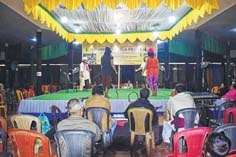
The state of Manipur has embraced all forms of art and music, dance and culture over the centuries with its set of traditions and customs unique not only in the Northeast but all over India, one of which being the Shumang Kumhei/Leela, a form of theatrical play with a travelling band of 12-15 artists. Having survived centuries, it has evolved not only as a popular pastime but also as an intrinsic space of infotainment where relevant themes of crime, corruption, social stigma and poverty are heavily discussed and re-enacted as part of the play.
When translated, "Shumang" means “courtyard” and "Kumhei" means “play". It became a form of entertainment that catered to the public’s need, and unlike regular theatre, which was in fact brought to the masses, it not only made itself convenient but also found itself to stay relevant according to the times, making commentary and critique on societal matters that otherwise would have been impossible. It was also a way of educating and supplying the masses with information on the state, the administration and important causes; therefore, it existed as a bridge between the audience and the fellow actors despite the “Shumang” existing as an interdimensional space using minimal stage setting of chairs, tables and other miscellaneous props, including the dangling mics, lights and sound system. Unlike regular theatre, the stage has a 360-degree overview of the audience, and thus actors make sure to switch their stations in the interval to be seen from all sides. Shumang Kumhei is of two types: Nupi Shumang Kumhei (exclusively women actors) and Nupa Shumang Kumhei (exclusively male actors), in which the latter is the most popular.
The evolution of Shumang Kumhei has been made successful through the existence of festivals like the Lai Haraoba (celebration of the Gods), where Tangkhul-Nurabi Loutaba, a form of ritualistic act, is performed, and the rise of various epic plays over the years. It pushed a leap with the introduction of scripts and music, becoming a full-fledged cultural identity of Manipur. What is so revolutionary about the Shumang Kumhei is the use of male actors to play even the female characters in a transvestic manner, which has truly opened up spaces for queer identity to become a medium of expression through extravagant costumes, stage makeup and aestheticism, allowing the existence of queer identities to flourish and feel respected in a society that is not so accepting of such unconventional individuals. They pride themselves as artists skilled in all forms of singing and dancing other than acting.
An art form that began primarily as entertainment has gradually evolved into a significant cultural medium that contributes to the progress and identity of Manipur. Today it is presented not only across different parts of Manipur but also on national and international platforms. This transformation becomes particularly evident when gender-fluid artistry occupies the centre of performance and develops into a distinctive tradition of the state. Within this practice lies what many understand as an open secret: the possibility of expressing one’s unique identity while at the same time avoiding social persecution and discovering a sense of community.
The journey of becoming a “Nupi Shaabi” is long and demanding. Aspiring performers undergo rigorous training under experienced gurus who guide them in mastering feminine mannerisms, emotional expression, and stage presence. Only after years of discipline are they allowed appearing on stage. Their performance involves a careful embodiment of femininity, where masculine and feminine identities coexist. The intention is not to erase one identity in favour of another but to represent both within the theatrical space.
On the “Shumang” stage, the portrayal of female characters is regarded as a highly respected role. Yet an important question arises regarding the performers’ identities beyond the stage. Many actors identify themselves as transgender individuals, and this raises concerns about how their lives function outside the imaginative world of performance. Do they receive the same admiration from the public that they enjoy during their performances, or are they confronted with prejudice and social distance?
The issue becomes more complex within the context of a highly conservative society where collective social norms strongly influence public attitudes. In such an environment, being labeled as “different” often results in marginalisation. Although these performers are celebrated as women on stage, their identities are rarely acknowledged in everyday life. Outside the performance space they are neither fully recognised as women nor accepted as transwomen. Consequently, they are denied the freedom to express themselves in the same manner as they do when they are appreciated as artists.
Over the years, many transgender individuals, known locally as “Nupi Manbi”, have entered the field of Shumang Kumhei. Despite the presence of a significant number of queer performers, the institution itself has long hesitated to recognise their identities openly. As a result, the space has not yet provided the meaningful representation that the queer community in Manipur continues to seek.
There is also a set of artists who play the role of Nupi Shaabi (men who play women characters) and do not wish to identify as queer. One can only imagine the hardships of openly presenting one’s identity as a potential risk, but the fluidity of theatrics that exists in Shumang Kumhei has, in many ways, the potential to break stereotypical aspects of masculinity and the prevailing outlook on femininity. Many of the Nupi Shaabi have a delicate and softer persona to truly present the character of a woman, but one may question whether it reinforces stereotypes of women being typecast where being soft-spoken and gentle makes her a good woman, while anything beyond that would make her a typical bad woman. This is depicted in terms of dressing and acting. Fictional it may be; however, over the years, one cannot help but recognise the pattern of the same script being repeated of the evil daughter-in-laws meant to break apart the family, the rebellious daughter and her subsequent downfall, the neighbourhood aunty who turns out to be the villain of the story, etc.
Shumang Kumhei is an overall male-dominated field, and with the decrease in female troops and artists in its space, it has forgotten and overtly dramatised the role of women as the ultimate villain of the story to drive a plot point. This does not help at all in Manipur where women are still being overlooked and undermined. Manipur prides itself on the many ways it upholds its women, but when it comes to uplifting them beyond their career and economic achievements, it is still lacking when the narrative still chooses to paint them as the evil homewrecker.
Queer identity, or the idea of queerness, is neither new nor foreign to Manipur. It has existed for centuries within the cultural and religious life of the region. For instance, the “Maibis”, the priestesses of the Meitei tradition, are often understood as embodying both masculine and feminine qualities.
In some cases, men also assume the role of female Maibis in ritual practices, performing sacred duties such as communicating with Meitei deities, conducting healing rituals, or participating in exorcism. These practices indicate that gender fluidity has long been present in local spiritual traditions. Therefore, queerness cannot be dismissed as a “Western” concept; rather, it has been an integral part of Manipuri society, though often obscured by the effects of colonial influence. Similar traditions can be seen across Asia, such as the Onnagata in Japanese theatre, the Peking Opera, the Jatra of Bengal, and the Nautanki of North India, where performance traditions intersect with gender expression.
Queerness has often been an act of resistance: the courage to live according to one’s own identity rather than conform to social expectations. In a small region like Manipur, it continues to survive through different cultural and artistic mediums. Even amid persistent communal tensions and administrative failures that disrupt everyday life, queer expression endures. It remains visible and meaningful, and perhaps in the future we may witness forms of art and entertainment where queer identities are represented honestly and respected both on and off the stage.
The fear that a community’s cultural identity may fade into insignificance often strengthens efforts to preserve its traditions. In Manipur, “Shumang Kumhei” stands as one such cherished art form. For generations, patrons and kings supported it not merely as entertainment but as a valued cultural expression. Proper promotion and funding should also ensure dignity and respect for the artists, recognising them as human beings as well as performers. Such support can help “Shumang Kumhei” remain an inclusive space that encourages broader acceptance of queer identities.
The writer is BA (Hons) English, Janki Devi Memorial College, University of Delhi and she can be reached [email protected]