‘ST demand not a matter to be negotiated or debated among communities’ WMC justifies demand, spells out reasons
|


By Our Staff Reporter
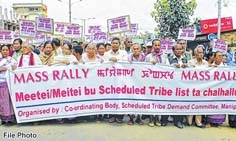
IMPHAL, Mar 10 : The right of the Meeteis to demand inclusion in the Scheduled Tribe (ST) list is not a matter to be debated or negotiated with communities already included in the list, the World Meetei Council (WMC) has said.
This assertion came after the All Naga Students' Association, Manipur (ANSAM) demanded clarifications from Congress MP Dr Bimol Akoijam on several issues including the Meeteis' demand for ST status.
In a statement released to the media today, the World Meetei Council categorically stated that the Meeteis' demand for ST status is the legitimate demand of the indigenous Meetei people and the community meets all the criteria laid down by the Lokur Committee which was established to revise the ST list.
World Meetei Council does not in any manner defend or support any political party or politician for their acts of omission or commission, but the Meetei community's demand for ST is not a matter to be debated or negotiated among communities, it said, reacting to ANSAM seeking clarification from MP Dr Bimol on the issue.
"...WMC would like to state clearly that the right of the Meeteis to demand inclusion in the Scheduled Tribe list is not a matter to be debated or negotiated among communities that are already included in the list, particularly within the State of Manipur," WMC said.
The indigenous Meetei of Manipur, whose total population of around 17 lakh in India is smaller than either the combined population of the Kuki-Zo groups or the Naga population, fulfil the criteria prescribed by the Lokur Committee for the Scheduled Tribe status, it said.
The Lokur Committee's five criteria include Primitive traits, Distinctive culture, Geographical isolation, Shyness of contact and Backwardness.
The indigenous Meetei community meets all the criteria to be included in the ST list, WMC said and explained--
The Meetei people though Hindus [not all], continue to maintain a deep and direct connection with their traditional deities. During traditional ceremonies such as Lai Haraoba and Saroi Khangba, even highly educated Meetei individuals follow the spiritual guidance conveyed through Maibis (priestesses who communicate with the deities). This tells about the continued existence of ancient spiritual traditions among them, WMC said.
Although Meeteis embraced Hinduism in the 18th century, traditional faith remains deeply rooted. Even today, almost every Meetei household maintains a sacred space in the south-western corner of the home dedicated to Lainingthou Sanamahi, the Supreme Household Deity, it said.
The present crisis in Manipur has also demonstrated the geographical isolation in which the Meeteis live. Without reliable road connectivity and with frequent blockades of National Highways, the Meeteis depend on air transport for access to the rest of India, WMC said.
Despite living alongside other communities, Meetei social practices remain restricted. Traditional ceremonies such as birth rites, marriages and death rituals are conducted within the Meetei community itself as they are not comfortable to mix with other communities, WMC said.
Economically, the majority of Meetei people continue to depend on subsistence livelihoods, it pointed out.
Nearly 90 percent of the population struggle to meet daily needs, while much of the business and commercial activity in the Imphal market area is dominated by trading communities from outside Manipur. The fact is, the role of the Meetei population in major commercial sectors remains marginal, WMC said.
Another serious concern is the cultural identity of the Meeteis. Nationally and internationally, Meeteis are often recognized through the Classical dance form Raas Leela, which is based on the Radha-Krishna narrative from the Mahabharata tradition. This is a reason why Meetei are called an advanced society by ANSAM and some others, WMC asserted.
Historically, the Meeteis adopted Hinduism in the 18th century and many were taught that they descended from Arjuna of the Mahabharata. However, such narratives should not obscure the fact that the Meeteis are aboriginal and indigenous inhabitants of Manipur with their own distinct cultural and historical identity, WMC said.
Today, the Meeteis face a serious identity crisis and an uncertain future, as they remain confined to the valley region of Manipur while demographic and political pressures continue to grow, it added.
Therefore, all communities across India, particularly those in Manipur, should not create obstacles to the legitimate aspirations of the Meetei people, WMC appealed.
"This [ST demand] is not a struggle against any community. It is a struggle for the future, dignity, and security of our children and generations to come," WMC said.